When my mother Andrea, my wife Clara and I – Christopher – decided to travel to Uganda this summer, our excitement came with a certain queasy feeling. After all, my last and only visit to Uganda had been 13 years earlier. In 2013 I was still a teenager, my English was much worse than it is today, and Uganda itself has changed since then.
My memories of that trip were mostly positive, but also marked by some uncertainty: the feeling of standing out almost everywhere as a white person, not always understanding the language, and not being able to expect the same comforts as in Europe. I particularly remember my first night in a hotel in Entebbe, when a rat suddenly ran through the bathroom.
A long journey
Our trip began at four in the morning. We flew from Hanover to Amsterdam, then on via Nairobi to Entebbe. There we were met by Kanaan, our driver, who was waiting for us on Elisabeth's behalf. A long night drive followed, through Kampala and Jinja heading east. I had heard that there are now good tarmac roads across the country. Experiencing it for myself was still a pleasant surprise – especially for our backs after the long journey.
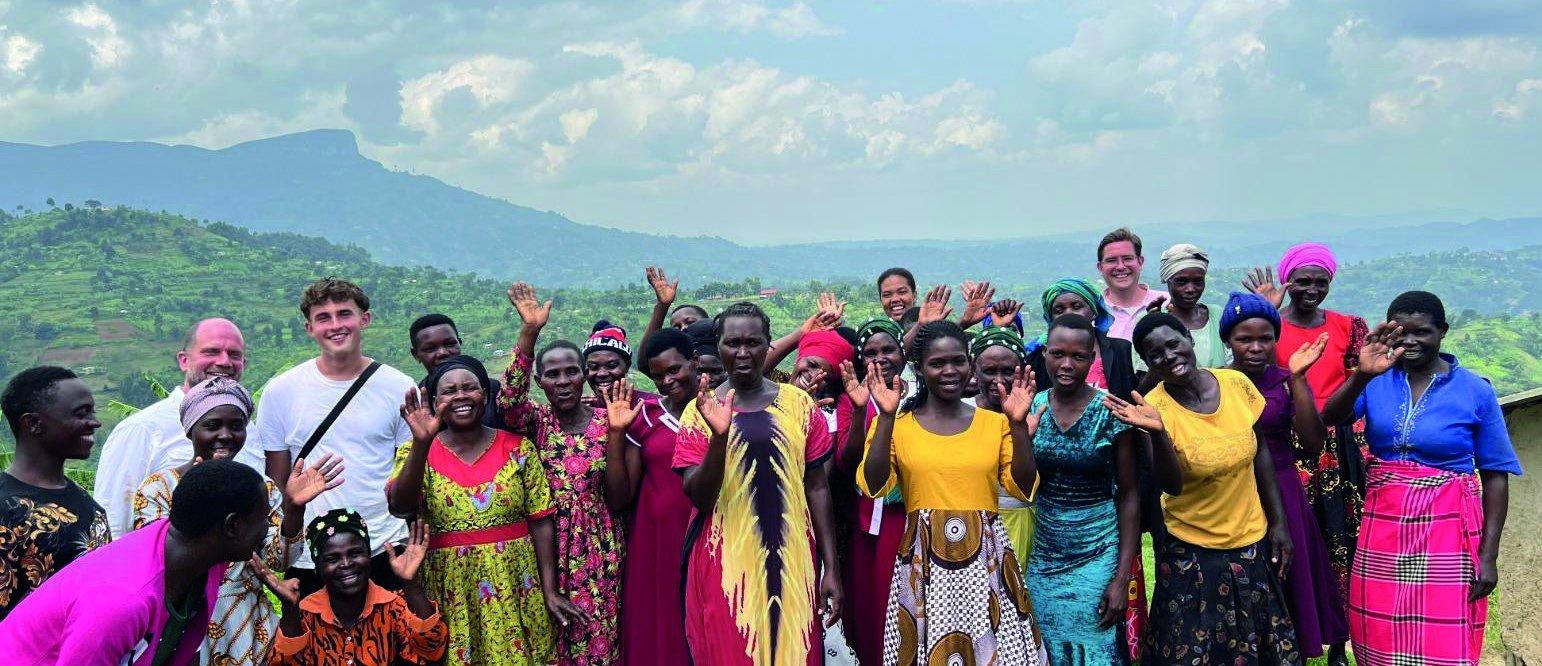
The next morning we finally reached Butiru and Elisabeth's new home. In 2013 she was still living in a house on the school grounds; now she has her own plot with a small holiday house. We were welcomed by Elisabeth and my cousins Hannah, Ruth and Christine, and straight away met the other housemates Isaac, Jotham, Moses, Peter and Papa Paul.
Seeing Butiru again
We spent the first week and a half of our trip in and around Butiru. Elisabeth and Ruth showed us the primary and secondary schools, Hope House and the Teachers' College, and gave us an insight into life there. A lot had changed since my last visit. The schools in particular had grown considerably.
While hardly anyone paid us special attention in Butiru, that changed the further we went. In Mbale, Munamba and other smaller places, and in the surrounding hills, we were of much more interest to many people.
We visited schools, looked at various projects, met people supported by micro-loans and finally even climbed one of the mountains. All the impressions and experiences would probably go beyond the scope of this report. Still, I'd like to highlight a few.
A day in Munamba
On the third day we rode boda-bodas (motorbike taxis) to Munamba, a neighbouring village of Butiru. First we visited the school, which, besides a primary and nursery school, also houses a vocational school. During our visit there was busy bricklaying, hairdressing and tailoring.
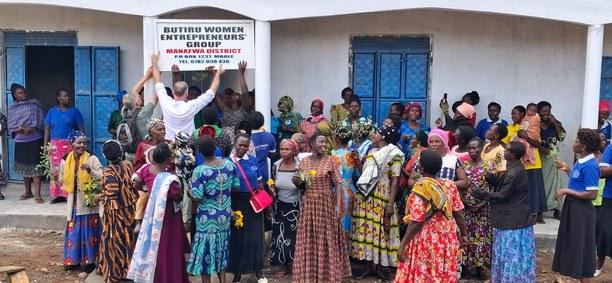
Then we visited several members of micro-credit groups. They showed us what they had built with their loans – in some cases dairy cows, in others small shops. The women we spoke with were very grateful for the chance to get a loan, and visibly proud of what they had built with the money. All in all it was a very positive and impressive experience.
Next we went to a water source protected by the Freundeskreis. It provides clean drinking water all year round for the people nearby. Many sources like this have been made possible in the region through such projects.
Finally we visited one of the many widows' houses, where we met a resident probably over 80 years old. She spoke no English, but her gratitude for her new home was easy to feel. Her former “house” was little more than a tiny hut of clay without windows, in very poor condition. The new building was a huge improvement in her life.
Climbing a mountain
As our Ugandan friends also had the weekend off, we wanted to go hiking in the mountains together. Peter advised sturdy shoes, just in case: the mountain was not only steep but could get very muddy in the rain. When we finally set off, it turned out the locals didn't necessarily share our concern and got on the motorbikes in flip-flops or similarly unsuitable shoes.
Our group of nine rode on six boda-bodas to the foot of the mountain, where it turned out that our drivers fancied the hike too.
The hike was indeed as tough as announced. The path led along narrow trails, past many small scattered settlements, up the steep mountain. Again and again we met puzzled locals who probably wondered why a bunch of young people would voluntarily drag themselves up such a steep mountain.
About halfway up, some of our group had had enough, and eight people decided to turn back. The rest battled on. On the way a local guide joined us and showed us the way. Without him we probably wouldn't have reached the summit – and the descent would likely have been tricky too, because just as we reached the top it began to pour.
Within moments the ground turned into one big slide. At times the path almost washed away under our feet, so that we slid more than walked on the way down. How the Ugandans managed to get up and down the mountain in their flip-flops in those conditions is still a mystery to me.
Getting to know the country
After our week and a half in Butiru we drove to Jinja and visited the famous “source of the Nile”, where the Nile flows out of Lake Victoria. Then we went on to Murchison Falls National Park. For two days we saw Uganda's wildlife up close. Elephants, rhinos, monkeys, gazelles, leopards, lions, giraffes, crocodiles and hippos – the list of animals we saw was long. Most impressive for us were the large herds of elephants and the search for lions. The moments when we searched for an animal for a long time and finally spotted it were among the highlights of the trip.
Looking back on those two weeks, I can only conclude that in that short time we gathered enough impressions and experiences for two or more holidays. My initial queasy feeling certainly wasn't borne out. Much has changed and been modernised since my last visit in 2013. Even so, Uganda remains a destination that's hard to compare with an ordinary holiday – in good ways and bad. As a white person you inevitably stand out, and especially outside the larger towns you're often watched closely. That can be tiring. At the same time, people almost everywhere met us with great friendliness, openness and helpfulness.
The country itself is full of contrasts, too. On one side there are impressive landscapes, fascinating flora and fauna and an incredible variety of impressions. On the other there are slums, traffic noise and in places massive plastic pollution. So Uganda is certainly not a destination where you can simply switch off and relax for two weeks. There's far too much to discover, experience and take in.
If you want to relax, you might be better off at the beach.