Bumusimbi
Miriam
Miriam from Bumusimbi, one of the four groups in Butiru, has built up a well-stocked shop, one loan at a time.
Livelihoods · Masaabaland
With a small loan, women from the villages around Butiru build a business of their own. In groups they vouch for each other, repay in small instalments – and support one another far beyond the money.
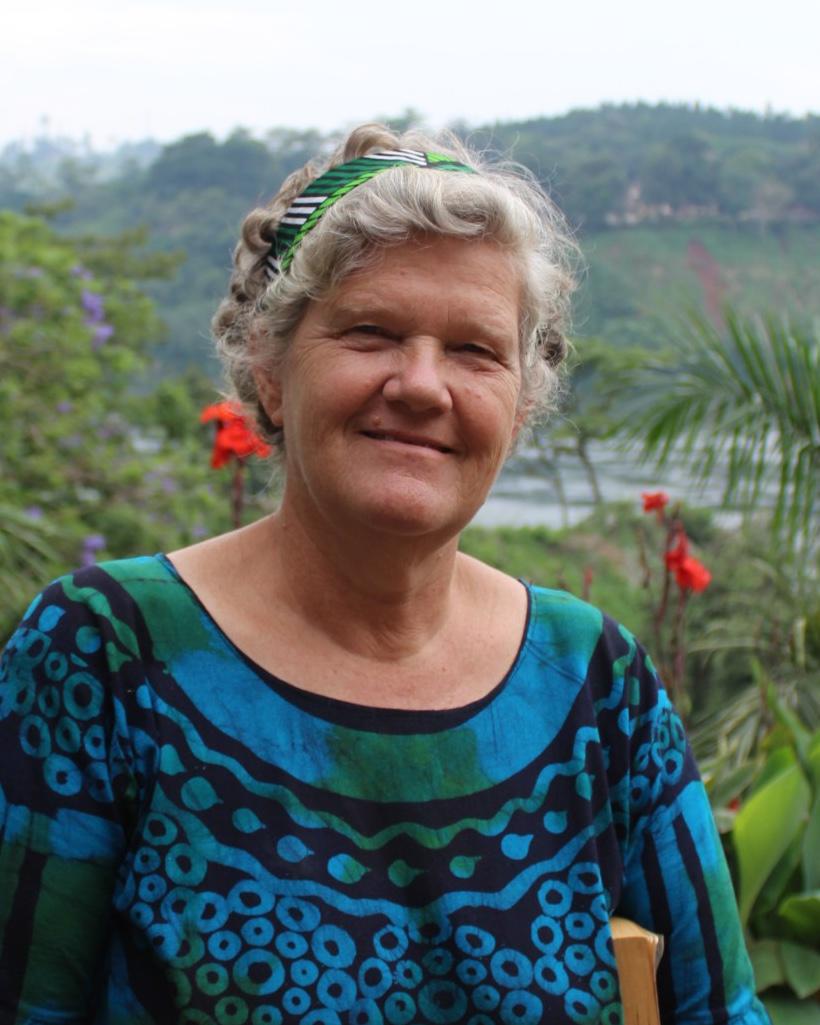 Elisabeth Mwaka · FounderFrom her report, Butiru, October 2026
The Bamasaaba, our people, live around Mount Elgon. In colonial times their land was divided between Kenya and Uganda, and the mountain – a massif 150 kilometres across – lost its name too: Masaaba, the people's ancestor, became Mount Elgon. Butiru lies on its southern foothills, where the land of the Jopadhola around Tororo begins.
Over the years we have come to see more and more how important it is to strengthen the independence and self-worth of the girls and women of our people.
In many clans girls are still valued by the bride price they will bring, and wives by how many children they bear. Slowly this is changing. Schooling for girls – at least to the end of primary school in seventh grade – is one of the most important ways: girls who finish primary school marry later, have fewer children and build a better life for themselves and their families.
When girls who had attended our secondary school in Busulwa no longer wanted to be married off for a bride price, there was a huge uproar there. Only after several meetings with the clan elders did things calm down.
In the last 15 years, with the help of the Freundeskreis, we have helped more than 45 villages start a primary school – with orphans we trained, who go back to their home villages as teachers.
The idea of supporting women in our villages with start-up money for small businesses came from a book by Muhammad Yunus about the Grameen Bank in Bangladesh. After some trial and error we adapted his system to our villages.
We have tested and adapted the system over the years. This is how it works in every new group.
In the village we explain the system in detail. There is plenty of time for business ideas and questions. At the end the group elects its committee: a chair, a secretary and a treasurer.
Each woman explains to the whole group what business she wants to invest in. Then the women form threes and vouch for each other. You think hard about whom to vouch for – unreliable women find no partners.
A week later the start capital, about €1,000, is handed to the group in front of all the women. First loans are usually no more than €50.
The group meets once a week, and every loan and repayment happens in front of everyone. The treasurer and the secretary – women who went to school at least up to fourth grade – each keep a large exercise book. If someone falls behind, the whole group knows.
Loans are repaid in 20 weekly instalments, with a one-off 10% interest. The interest stays in the group: it grows the capital and covers losses, for example if a borrower falls ill or dies.
A woman who has repaid her first loan may borrow more the next time. Many simply keep paying their weekly instalment afterwards – as savings that are credited to them and keep growing the group's capital.
The interest stays in the group.
A woman who repays her first loan reliably may borrow more the next time. Step by step, quite a few women have built up remarkable businesses this way.
Bumusimbi
Miriam from Bumusimbi, one of the four groups in Butiru, has built up a well-stocked shop, one loan at a time.
Buwetsalo
With her first loan Lydia opened a roadside restaurant in Buwetsalo. It lets her pay her weekly instalments easily and take better care of her family.
USh 15,000profit a day, about €3.80
Annet, Sylvia, Harriet, Jennifer and Mary are just a few of the many women whose lives a small loan has changed.
The weekly meetings are about more than business ideas and instalments. The women also talk about whatever else weighs on them, and help each other – from the harvest to childbirth.
What do you do when a relative becomes abusive? When a widow's clan wants to take her land, or force her to marry her late husband's brother as a second or third wife so that the property stays in the clan?
Bunabwana
In Bunabwana a widow's clan wanted to take her land because she refused to become her brother-in-law's third wife. The women's group took up her case and negotiated with the clan elders – until she got all of her land back.
And two goats on top, so her children have milk.
The groups are also a good foundation for health education and family planning. In our area a woman still has six to seven children on average – often more than she can care for. And because land is divided again with every inheritance, it is growing scarce.
Four midwives work at the hospital; one of them regularly visits the villages with Pastor Emmanuel Welikhe. The District Health Officer supports the programme: the midwives report to him, and he provides medicines, gloves and educational material.
In the villages they work with community health workers, the 'barefoot doctors' – mostly traditional birth attendants who learned from their mothers and grandmothers. For a long time there was a deep divide between them and trained health workers. For many years now we have invited them to the hospital regularly for a good cup of tea, and the divide keeps shrinking. Customs such as rubbing cow dung on newborns' navels against evil spirits, which often caused tetanus, no longer happen in our area.
Several groups make up a zone that is looked after together. Each zone has a letter, and neighbouring zones have different colours. Choose a zone to learn more.
Each zone is shown at roughly the middle of its area.Simplified map, border approximate.Inset: Natural Earth · Lakes: © OpenStreetMap contributors
The small loans lay an important foundation for all of this. With their own businesses and income, the women's self-worth grows. They no longer see themselves as merely goods the clan sells for a bride price. And younger, unmarried women find a better way, too, than being kept by 'sugar daddies'.
As the map shows, we currently reach only a small part of Masaabaland. We would be very happy to extend this work to other areas in the coming years.
Elisabeth MwakaFounder and coordinator of all projectsEnough for about 20 first loans. What the women repay stays in the group and becomes the next loan.